
The marketing budget conversation for Calgary small businesses often frames print and digital as competing choices. This framing misses a fundamental reality: in a city where 93% of residents own or lease a vehicle, where the Calgary Stampede attracts nearly 1.5 million visitors in just 10 days, and where distinct commercial districts create intense storefront competition, certain printed materials deliver cost-per-impression economics that digital channels cannot replicate for local reach.
The question is not whether to invest in print, but which printed products generate measurable returns for businesses operating with typical small business marketing budgets of $600-800 CAD monthly. Four categories stand out for their ability to create persistent visibility in Calgary’s physically competitive, automotive-oriented commercial environment.
- Why Calgary small businesses still need printed materials in 2026
- Business cards that create tangible connections
- Outdoor signage: your silent sales representative working 24/7
- How vehicle graphics multiply your brand visibility across Calgary
- Event banners and seasonal promotional displays
- Which printed product should you invest in first?
- What mistakes do Calgary businesses make with print marketing?
- Building your print marketing foundation strategically
Why Calgary small businesses still need printed materials in 2026
Digital marketing saturation has reached a point where declining organic reach, rising ad costs, and widespread banner blindness create an opening for physical materials that maintain uninterrupted visibility. A Facebook ad stops generating impressions the moment spending stops. A professionally installed storefront sign in Kensington generates impressions 24 hours daily for 5-7 years from a single investment.
Calgary’s specific characteristics amplify the effectiveness of certain print categories beyond typical expectations. The city’s automotive culture matters quantitatively: according to Turo’s 2026 study on Canadian car ownership, 93% of Calgarians own or lease a vehicle, significantly exceeding the national average of 85%. This creates extraordinary exposure to vehicle-based advertising that would underperform in transit-dependent cities.
93%
vehicle ownership
Calgary leads Canadian cities in household vehicle ownership, creating ideal conditions for mobile print marketing like vehicle wraps and outdoor signage visible to drivers.
The city’s event density provides recurring physical marketing windows. Calgary hosts more than 50 major festivals and commercial events annually, with the Calgary Stampede alone attracting 1,477,953 visitors in 2024 according to CBC News. These concentrated foot traffic periods reward businesses that deploy event-ready printed materials.
Distinct commercial districts like Kensington, 17th Avenue, and Inglewood create competitive storefront environments where physical differentiation becomes commercially decisive. Instagram presence alone cannot attract walk-in customers when competing chain stores operate within 500 metres. Physical touchpoints create trust and permanence that ephemeral digital impressions struggle to replicate for neighborhood-based businesses.
Business cards that create tangible connections

Business cards remain essential in Calgary networking contexts where digital alternatives feel impersonal or impractical. Chamber of commerce events, Calgary Stampede business networking functions, trade shows, and industry association meetings create situations where physical card exchanges establish professional credibility that LinkedIn connection requests cannot replicate in the moment.
The critical decision involves initial order quantity and quality level. The most expensive mistake new businesses make: ordering 5,000 cards before validating brand identity through market testing. Businesses refine messaging, adjust pricing structures, and update contact information frequently during the first year. Large initial orders create obsolete inventory when inevitable adjustments occur.
Avoid the 5,000-card trap: Order 250-500 business cards for initial runs. This quantity provides sufficient supply for several months of networking while maintaining flexibility to incorporate brand refinements as the business matures, preventing waste of $200-400 on obsolete inventory.
Quality differentiators that impact professional perception include paper weight (minimum 14pt for substantial feel), finish selection (matte conveys sophistication for premium services, gloss works for retail and hospitality), and design simplicity versus information overcrowding. Calgary print shops typically offer three pricing tiers: economy cards ($20-40 per 500), mid-range ($60-100 per 500), and premium ($120-180 per 500) with quality differences visible in paper texture, color accuracy, and edge finishing.
The investment level should match business maturity and target audience expectations. A premium restaurant justifies $150 investment in 500 high-quality cards with specialty finishes. A construction contractor prioritizes durability and readability over premium paper stock. The card quality signals brand positioning before any verbal interaction occurs.
Essential elements checklist: Verify cards include name, title, phone number, email, website, and physical address if location matters for the business. Missing critical information requires costly reprints. Simple, uncluttered layouts with ample white space outperform designs that cram excessive information into limited space.
Outdoor signage: your silent sales representative working 24/7
Outdoor signage investment intimidates budget-conscious business owners when quotes reach $3,000, but the ROI calculation over a 5-7 year lifespan demonstrates cost-efficiency that few digital channels can match. The framework: daily foot traffic impressions multiplied by 365 days multiplied by expected lifespan in years equals total impressions. Dividing total signage cost by total impressions yields cost-per-impression.
Consider a café in Kensington experiencing 500 daily pedestrian impressions. Over five years, that single sign generates 912,500 impressions. A $3,000 investment produces a cost-per-impression of $0.0033, or roughly one-third of one cent per view. Facebook ads in Calgary typically cost $5-15 CPM (cost per thousand impressions), requiring continuous spending to maintain visibility.
Location dramatically impacts investment justification. High-traffic Calgary commercial districts like 17th Avenue, Kensington retail strips, and Inglewood’s main corridors generate sufficient daily impressions to justify premium illuminated signage ($3,000-5,000). Lower-traffic industrial areas or residential neighborhoods may prioritize vehicle graphics for mobile visibility instead, matching marketing investment to actual audience exposure patterns.
Calgary municipal signage regulations vary by district and Business Improvement Area. Permit requirements, size restrictions, and design standards differ between neighborhoods. Kensington BIA maintains specific aesthetic guidelines. Verifying compliance before production prevents enforcement issues and potential removal orders that waste the entire investment.
Signage options span budget tiers: basic channel letters ($1,500-2,500) provide dimensional visibility, illuminated cabinet signs ($3,000-5,000) extend effectiveness into evening hours when pedestrian and vehicle traffic continues, and premium dimensional signs with specialty lighting ($5,000-8,000) create distinctive landmarks in competitive districts. The appropriate tier depends on actual foot traffic volume, operating hours, and competitive density in the specific location.
Calgary’s prairie climate requires weather-resistant materials and construction that withstand temperature extremes, wind exposure, and precipitation. Quality installation and durable materials extend effective lifespan, improving long-term cost-per-impression calculations. Specialists like Bold Signs & Graphics understand local climate requirements and municipal regulations, helping businesses avoid common specification errors that shorten signage lifespan or create compliance problems.
How vehicle graphics multiply your brand visibility across Calgary
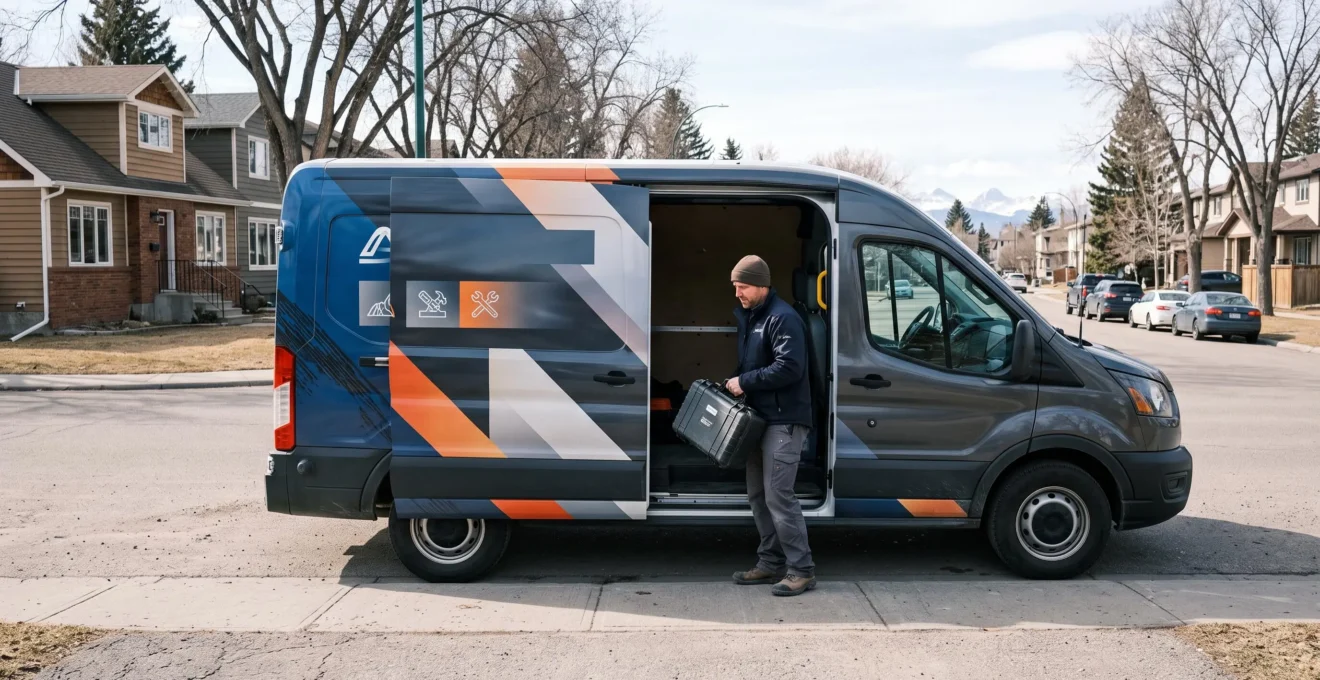
Vehicle graphics create disproportionate ROI specifically in automotive cities where high ownership rates and car-dependent commuting patterns maximize exposure. Industry research consistently shows that wrapped vehicles in urban environments generate 30,000-70,000 impressions daily, transforming every business trip into mobile advertising.
The cost-per-impression calculation demonstrates unusual efficiency. A typical full vehicle wrap costs $3,500-5,500 in Calgary depending on vehicle size and design complexity. At the conservative estimate of 30,000 daily impressions, a wrapped vehicle generates 10,950,000 impressions annually. Even at the higher $5,500 investment, the first-year cost-per-impression equals $0.0005, or five one-hundredths of one cent per view. After the first year, ongoing impressions continue at zero additional cost for the 3-5 year wrap lifespan.
Full wrap versus partial graphics involves clear trade-offs. Full wraps ($3,500-5,500) maximize visibility and convey professionalism through complete vehicle transformation. Partial graphics ($1,200-2,500) offer budget entry points with strategic placement on doors and rear panels, capturing significant visibility at roughly half the investment. The appropriate choice depends on vehicle usage patterns, competitive intensity, and available budget.
Vehicle graphics investment levels for Calgary small businesses:
| Option | Investment Range (CAD) | Visibility Level | Best For |
|---|---|---|---|
| Magnetic signs | $150-400 | Basic | Testing concept, removable branding |
| Partial wrap (doors/rear) | $1,200-2,500 | Moderate | Budget-conscious service businesses |
| Full vehicle wrap | $3,500-5,500 | Maximum | Mobile services, delivery, construction |
Industries with disproportionate benefit include mobile services (plumbing, HVAC, landscaping), delivery businesses, real estate, and construction—any sector requiring frequent local travel. Businesses primarily office-based or conducting work at client sites with parked vehicles hidden from public view gain minimal advantage. Vehicle graphics work when vehicles spend time on Calgary roads where the 93% of residents who own vehicles can see them repeatedly.
Calgary’s climate requires professional-grade vinyl materials and installation expertise. Temperature extremes and sun exposure affect longevity. Quality materials and proper application extend effective lifespan to 5-7 years, while budget vinyl or improper installation may fail within 2-3 years, destroying the cost-per-impression advantage through premature replacement needs.
Event banners and seasonal promotional displays

Event banners merit consideration in Calgary specifically because event frequency creates multiple deployment opportunities versus one-time usage. The city’s 50+ major festivals and commercial events annually provide recurring high-traffic windows where banner visibility generates concentrated ROI.
The Calgary Stampede represents the single largest annual visibility opportunity. With nearly 1.5 million visitors attending in 2024, businesses participating in or located near Stampede activities face extraordinary exposure potential during the 10-day event. A well-designed banner deployed during Stampede alone can generate more impressions than months of typical social media posting.
Purchase versus rental economics depend on intended usage frequency. Banner ownership costs $200-600 depending on size and quality (retractable banners at the lower range, large outdoor-grade banners at the higher range). Rental typically costs $75-150 per event. The ownership investment becomes cost-effective after 2-3 event deployments, making purchase the logical choice for businesses planning multiple event participations annually.
Reusability design strategy maximizes value across multiple occasions. Generic brand messaging rather than event-specific or date-specific content allows deployment at Calgary Farmers’ Markets, Kensington Art & Wine Festival, Inglewood Sunfest, Lilac Festival, and neighborhood business expos without requiring new production. A $400 banner investment deployed at 15 events over two years yields a cost-per-deployment of approximately $27, far below single-event rental costs.
Seasonal retail businesses operating booths at Calgary Farmers’ Markets from May through October face 20+ potential deployment opportunities from a single banner investment. The accumulated impressions from consistent presence across the farmers’ market season build neighborhood brand recognition that sporadic participation cannot achieve.
Which printed product should you invest in first?
Budget constraints require prioritization rather than simultaneous multi-channel launches. The decision framework combines available budget, business sector characteristics, and development stage to eliminate analysis paralysis.
Budget-tiered priorities provide immediate guidance. With $300 available, invest in 300-500 quality business cards only, establishing professional credibility in networking contexts. With $500-800 monthly budget, add either partial vehicle graphics or basic outdoor signage depending on sector (mobile services prioritize vehicle, storefront retail prioritizes signage). With $1,000-2,000, combine outdoor signage, business cards, and a reusable event banner. Above $2,000, full vehicle wrap plus outdoor signage plus business cards creates comprehensive physical presence.
- Mobile service businesses (plumbing, HVAC, landscaping, delivery):
Prioritize vehicle graphics first (partial wrap $1,200-2,500, full wrap $3,500-5,500) because every service call generates thousands of impressions across different Calgary neighborhoods. Add business cards second ($60-180 for 500 mid-to-premium quality).
- Storefront retail and hospitality (cafés, boutiques, restaurants):
Prioritize outdoor signage first ($1,500-5,000 depending on location traffic and hours) to capture foot traffic in competitive districts like Kensington or 17th Avenue. Add premium business cards second ($120-180 for 500) to match the quality positioning.
- Professional services (consulting, accounting, legal, design):
Prioritize premium business cards first ($120-180 for 500) as primary networking tool. Add outdoor signage only if operating from visible street-level office; otherwise invest in event banners ($200-600) for trade shows and professional conferences.
- Event-based and seasonal businesses:
Prioritize reusable event banners first ($200-600) for Calgary Farmers’ Markets, festivals, and pop-ups. Add business cards second ($60-100 for 500 mid-range) for direct customer interactions at events.
Development stage affects investment strategy. Launch phase businesses (0-6 months) prioritize flexibility through smaller card orders and partial vehicle graphics, maintaining agility to refine messaging as customer feedback clarifies positioning. Growth phase businesses (6-24 months) prioritize visibility scaling through full outdoor signage and complete vehicle wraps. Established businesses focus on quality upgrades and consistency across all materials.
Sequential investment pathway reduces overwhelm. Most businesses should follow: business cards first (immediate networking capability), then outdoor signage or vehicle graphics based on sector (choose the channel matching primary customer acquisition pattern), then event banners (once brand identity is validated). This progression spreads investment across quarters rather than requiring large upfront commitments before revenue validates the business model.
What mistakes do Calgary businesses make with print marketing?
The most expensive error: ordering 5,000 business cards before brand validation. Businesses refine messaging, adjust contact information, and update positioning frequently during the first year. Massive initial orders create obsolete inventory when inevitable changes occur, wasting $200-400 on cards that cannot be used. The conservative approach—ordering 250-500 cards initially—provides several months of supply while maintaining flexibility to incorporate refinements.
Visual inconsistency across print materials undermines brand recognition. Using different logo versions, color schemes, or fonts between business cards, outdoor signage, and vehicle graphics creates confusion rather than reinforcement. Each print investment should strengthen a unified brand identity. Inconsistent materials dilute limited marketing budgets by failing to build cumulative recognition.
Top three financially damaging mistakes: (1) Ordering 5,000 cards initially instead of 250-500 (wastes $200-400 on obsolete inventory), (2) Installing outdoor signage without verifying Calgary municipal permits and BIA requirements (risks fines and forced removal of $2,500+ investment), (3) Deploying print materials without tracking mechanisms (prevents ROI measurement and optimization).
Ignoring Calgary municipal signage regulations creates compliance penalties. Different Business Improvement Areas maintain distinct aesthetic guidelines and size restrictions. Kensington, 17th Avenue, and Inglewood each have specific requirements. Proceeding with outdoor signage design and installation without verifying permit requirements risks enforcement actions requiring expensive modifications or complete removal, destroying the investment.
Absence of tracking mechanisms makes ROI assessment impossible. Simple effectiveness measurement—dedicated phone numbers on vehicle graphics, promo codes on event banners, training staff to ask new customers how they discovered the business—enables data-driven decisions. Without tracking, businesses cannot determine which print investments generate returns and which waste budget. A basic spreadsheet tracking customer source provides sufficient data to optimize future investments.
Neglecting technical specifications causes quality issues requiring expensive reprints. Low-resolution images, incorrect color profiles (RGB files instead of CMYK for print), and inadequate bleed margins produce poor results. Working with experienced Calgary print providers who verify files before production prevents these technical failures.
Building your print marketing foundation strategically
The immediate next step: conduct a visual brand consistency audit. Gather all existing materials—digital logos, preliminary designs, any previous print samples—to identify inconsistencies in logo usage, colors, fonts, and messaging before investing in any new production. This audit prevents the costly mistake of producing print materials that fail to reinforce a unified brand identity.
Selecting Calgary print vendors requires evaluating specific criteria beyond price. Request portfolios showing local work, verify understanding of municipal regulations (particularly important for outdoor signage subject to permit requirements), compare minimum three quotes to establish reasonable pricing ranges, and assess whether the provider offers design consultation or simply processes orders. Quality vendors prevent technical and compliance mistakes while optimizing budget allocation.
Map print investments to Calgary’s event calendar. Align banner production deadlines with major festivals (Stampede participation requires preparation by May-June), schedule signage installation before high-traffic seasons, and time vehicle graphics application during slower business periods when vehicles can be unavailable for 2-3 days. Coordinating visibility investments with peak opportunity windows maximizes ROI.
Implement tracking mechanisms from launch. Assign unique promo codes to different print materials, train staff to consistently ask new customers about discovery source, and create a simple spreadsheet recording responses. This data transforms print marketing from unaccountable expense into measurable investment, enabling evidence-based decisions about future budget allocation. The tracking overhead requires minimal time but provides critical information preventing continued investment in underperforming channels.
A practical 90-day implementation timeline: Month 1 focuses on brand audit and vendor selection (request quotes, review portfolios, verify references). Month 2 executes the first priority investment from the decision matrix matching business type and budget. Month 3 implements tracking systems and evaluates initial results before committing to the next investment. This pacing prevents rushed decisions while building momentum through visible progress.
Calgary-specific resources support implementation. The Calgary Chamber of Commerce maintains a vendor directory including print specialists. Individual Business Improvement Areas (Kensington BIA, 17th Avenue BIA, Inglewood BIA) provide aesthetic guidelines and permit assistance for outdoor signage. Calgary Economic Development publishes the annual events calendar useful for planning banner deployment and timing visibility investments around peak traffic periods. For businesses seeking guidance on maintaining visual consistency across print and digital channels, resources like this graphic style guide in English provide frameworks for creating brand standards before production begins.
Five immediate actions to begin print marketing implementation today:
- Audit current brand materials for consistency across logo usage, colors, fonts, and messaging before ordering any print production
- Request itemized quotes from three Calgary print vendors to establish realistic pricing ranges for priority products matching business type
- Download Calgary Economic Development’s annual events calendar to identify strategic banner deployment opportunities throughout the year
- Choose first investment from the budget-and-sector decision matrix: vehicle graphics for mobile services, outdoor signage for storefront retail, premium business cards for professional services
- Create a simple customer source tracking spreadsheet with columns for date, customer name, print material mentioned, and purchase value to measure effectiveness from launch
Print marketing delivers measurable returns for Calgary small businesses when investments match the city’s automotive culture, event density, and competitive commercial districts. The four priority categories—business cards, outdoor signage, vehicle graphics, and event banners—each serve distinct functions within an integrated visibility strategy. Strategic sequencing, realistic budgets, and consistent tracking transform print from uncertain expense into accountable channel generating persistent impressions that digital alternatives cannot replicate at comparable cost-per-view economics.
Physical presence matters in markets where the impact of street furniture and built environment shape daily commercial interactions. Calgary’s specific characteristics—vehicle dependency, festival culture, neighborhood competition—create conditions where certain printed materials outperform typical expectations. The competitive advantage belongs to businesses that recognize print and digital as complementary channels requiring coordinated investment rather than competing budget allocations.