
A production line stands still for 48 hours because a batch of components failed after a discharge nobody saw, heard or felt. For any Health & Safety Manager running an electronics facility, that scenario is not hypothetical anxiety — it is the kind of event that turns ESD protection from a compliance line item into a boardroom conversation. The core question this article answers is practical: how can you ensure your staff are properly equipped for ESD protection while managing a tight budget and demonstrating clear value to financial decision-makers?
The argument developed here is deliberately framed around investment rather than obligation. Effective ESD equipment protects three things at once — physical assets, production continuity and the people wearing it. The sections below set out why the risk deserves priority now, what equipment standards such as BS EN IEC 61340-5-1:2024 actually require, how to assess whether existing gear is still fit for purpose, and how to build a working culture that survives beyond the next audit.
This article provides general information for workplace safety professionals in the UK. It does not replace a site-specific risk assessment carried out by a competent person, nor a review of the current editions of the standards referenced. Equipment decisions should always be validated against your own processes, component sensitivity levels and regulatory obligations.
- BS EN IEC 61340-5-1:2024 is the UK-adopted reference standard for ESD control programmes, covering components with withstand voltages of 100 V HBM and above.
- HSE guidance requires employers to provide sufficient information, instruction and training whenever PPE — including ESD personal grounding equipment — is issued.
- Equipment age alone is not proof of failure, but periodic testing and documented verification are essential to demonstrate ongoing compliance.
- Choosing between economy and premium equipment should rest on total cost of ownership, not purchase price.
- Why ESD Protection Remains a Critical Workplace Priority in 2026
- What Risks Do Unprotected Staff Face in ESD-Sensitive Environments?
- Which Personal Grounding Equipment Should Your Team Be Using?
- Compliance Standards Every Safety Manager Must Know
- How to Assess If Your Current ESD Protection Is Adequate
- Common Implementation Mistakes and Building a Sustainable ESD Culture
Why ESD Protection Remains a Critical Workplace Priority in 2026
Consider an illustrative scenario drawn from patterns reported across electronics manufacturing: a single production stoppage caused by damaged components can cost a mid-sized facility tens of thousands of pounds in scrapped stock, investigation time and lost output. Set against that figure, the cost of equipping a workforce with verified wrist straps, footwear and grounded workstations is modest. That asymmetry is the financial case for ESD protection in a single sentence.
£15,000illustrative loss
A representative scenario for a mid-sized electronics facility: 48 hours of production downtime following undetected ESD damage to components. Figures of this magnitude are site-specific; your own incident and downtime costs should be used when building a business case.
The regulatory backdrop also matters. The UK-adopted standard BS EN IEC 61340-5-1:2024 establishes the administrative and technical requirements for an ESD control programme wherever electrical or electronic parts with withstand voltages of 100 V HBM, 200 V CDM (or 35 V for isolated conductors) are handled. Its scope is defined and limited: it does not apply to explosive devices or to flammable liquids, gases or powders. Knowing where the standard applies — and where it does not — is the first step in defending any protection programme during an audit.
There is a second, often overlooked reason to act before an incident forces the issue. Modern components are continually miniaturised, and their vulnerability to electrostatic phenomena has prompted successive revisions of the standards. Equipment purchased five years ago may have been compliant at the time, yet the components now passing through your facility may be considerably more sensitive than those it was specified to protect. The logical consequence: an old kit can be technically intact and still inadequate for today’s products.
Latent ESD damage — the hidden threat : Not all ESD failures announce themselves. Some damaged components pass final test and degrade in the field, surfacing as warranty returns or customer complaints long after shipment. Without periodic verification of grounding equipment, this invisible failure mode undermines any sense of security derived from “no recent incidents”.
Framing the investment correctly also helps with internal communication. Treating ESD protection purely as a compliance cost invites minimum spending; treating it as the intersection of asset protection, production continuity and workforce safety justifies spending measured against the losses it prevents.
What Risks Do Unprotected Staff Face in ESD-Sensitive Environments?
Electrostatic discharge is a transfer of charge between two objects at different electrical potentials. In practice, it originates from everyday movements — walking, removing clothing, handling packaging — through what is known as the triboelectric effect. The person involved feels nothing, yet the discharge may far exceed what a sensitive component can tolerate.
The scale of that gap is captured in the reference standard itself. BS EN IEC 61340-5-1:2024 sets its protection baseline for components with withstand voltages of 100 V HBM and above — a level far below any sensation a human being can perceive. An operator can therefore destroy a part without any warning sign, which is precisely why engineering controls and personal grounding matter more than intuition.
The consequences fall into two categories with very different cost profiles. Catastrophic failures are detected immediately: the component fails in production or at test, generating scrap and downtime. Latent failures are more insidious — the component is degraded but functional, ships to a customer, and fails later in service. The second category carries warranty, reputational and corrective-action costs that rarely appear on the same budget line as the original incident.
Risks also differ by environment, and a facility with multiple zones should not apply a single template everywhere. In a standard assembly workshop, the main exposure comes from ungrounded operators handling PCBs at their benches. In an ISO-classified cleanroom, garment requirements are stricter and footwear must be compatible with the contamination regime. In a test laboratory, where handling is occasional but component sensitivity can be extreme, targeted measures such as grounded mats and adjustable wrist straps are often proportionate.
| Factor | Assembly workshop | ISO 7 cleanroom | Test laboratory |
|---|---|---|---|
| Main risk source | Ungrounded operators at benches | Garment and footwear interaction | Occasional handling of highly sensitive parts |
| Typical personal grounding | Wrist strap plus heel grounders | Integrated conductive garment, footwear and wrist strap | Adjustable wrist strap and grounded mat |
| Key constraint | Mobility across the floor | Combined ESD and contamination compliance | Budget-proportionate targeted protection |
Finally, there is the human and legal dimension. Where ESD equipment qualifies as personal protective equipment (PPE), UK health and safety law places duties on the employer — duties that extend beyond simply issuing the kit, as the next section on standards makes explicit.
Which Personal Grounding Equipment Should Your Team Be Using?
The recognised categories of personal grounding equipment are well established and map directly to working situations. Selecting among them is less about cataloguing products and more about matching function to environment, component sensitivity and operator mobility.
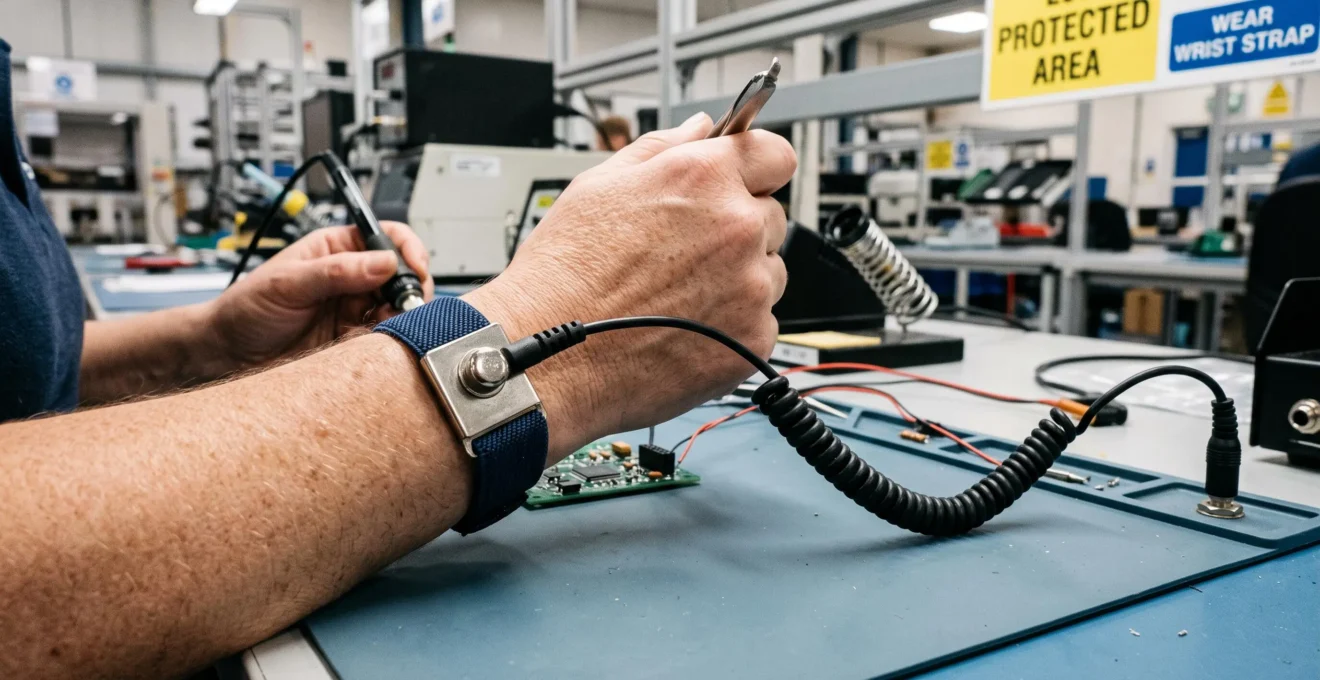
- Wrist straps: the benchmark for seated or fixed-station work, providing a continuous path from the operator’s skin to a grounding point.
- Heel grounders: suitable for operators who move between stations, grounding through conductive flooring.
- ESD footwear: a more durable and comfortable alternative to heel grounders for staff who are on their feet all day, again relying on dissipative floors.
- ESD garments: conductive smocks that control charge on clothing, particularly relevant in cleanroom environments.
Budget tiers reflect genuine differences, not just branding. Economy wrist straps may meet the electrical requirements on day one, but premium items typically offer more robust cords, better skin-contact materials and longer service life — differences that show up in replacement frequency and, critically, in test pass rates over time. The honest comparison is total cost of ownership: a cheaper strap that fails its monthly test after six months is not cheaper than a durable one that lasts a year.
For cleanroom applications, complete kits — where garment, footwear and grounding elements are designed to work together — reduce the risk of incompatible items undermining the whole system, and typically shorten the time each operator spends gearing up at shift start. Sourcing from established ESD personal protective equipment suppliers also simplifies traceability, since conformity documentation for each component should be obtainable on request — a point that matters when an auditor asks for evidence.
- Fixed workstation, frequent component handling :
A wrist strap connected to a grounded mat and bench is the core solution. Budget can go into strap quality and a reliable tester rather than elaborate garments.
- Mobile operator on conductive flooring :
Heel grounders or ESD footwear are the priority, since a wrist strap cannot serve someone walking between stations. Verify the floor itself is dissipative and tested.
- ISO-classified cleanroom :
An integrated kit — conductive garment, footwear and wrist strap — avoids compatibility gaps and satisfies both ESD and contamination requirements simultaneously.
- Occasional handling in a laboratory :
An adjustable wrist strap and a grounded mat at the handling point offer proportionate protection without over-equipping infrequent users.
Replacement cycles deserve attention in any multi-year budget. Manufacturers’ guidance varies, and no universal figure replaces periodic testing, but planning for consumable items — strap bands, cords, heel grounder pads — as recurring expenditure rather than one-off purchases prevents the quiet drift into unverified equipment.
Compliance Standards Every Safety Manager Must Know
Two frameworks dominate the ESD compliance landscape, and they work together rather than compete. The first is IEC 61340-5-1, the international standard adopted in the UK as BS EN IEC 61340-5-1:2024. It defines what an ESD control programme must achieve — administrative requirements, technical requirements, and periodic verification — for the handling of electronic parts within its stated voltage scope.
The second is ANSI/ESD S20.20, the US-developed programme standard from the ESD Association. In practical terms, both standards converge on the same architecture: a documented ESD control programme plan, personnel grounding, protected areas, and regular verification of equipment. For a UK site, BS EN IEC 61340-5-1 is the natural primary reference; familiarity with S20.20 remains useful where customers or contracts cite it.
Alongside these technical standards sits UK health and safety law. HSE guidance on PPE at work — applying the Personal Protective Equipment at Work Regulations as amended in 2022 — is unambiguous: where PPE is required, employers must ensure their workers have sufficient information, instruction and training on its use. The employer also remains responsible for maintaining, storing and replacing the equipment provided. In other words, issuing wrist straps without training and a maintenance regime is not merely ineffective; it falls short of official guidance published by the Health and Safety Executive.
A few practical compliance criteria complete the picture. PPE should be treated as a control of last resort, once workplace and process measures have been considered. New PPE must carry CE marking, signalling that it meets basic safety requirements. PPE must be provided free of charge to employees, including agency workers. And the risk assessment underpinning the whole programme must be carried out by a competent person with the necessary knowledge and experience — a requirement reflected in guidance from HSE Northern Ireland as well.
- Confirm the standard applies to your activities
Check that the components you handle fall within the voltage scope (100 V HBM, 200 V CDM, 35 V for isolated conductors) and that your activities are not among the standard’s stated exclusions.
- Ground all personnel handling sensitive components
Every person touching unprotected ESD-sensitive items must be connected to an effective grounding system — typically wrist strap or footwear-plus-floor combinations.
- Verify equipment periodically
The standard requires ongoing verification, not a one-off conformity check. Define test frequency, methods and acceptance limits in your ESD control programme plan.
- Train and inform your staff
Align with HSE PPE guidance: workers must receive sufficient information, instruction and training on the equipment they are asked to use.
- Document everything
Keep test records, training logs and equipment conformity certificates in a form you can produce during an HSE audit or customer quality visit.
Beyond ESD — protecting your certifications : ESD compliance does not sit in a vacuum. Quality management systems such as ISO 9001 expect documented, verified processes; an uncontrolled ESD risk in a cleanroom can also call the facility’s classification into question. Treating the ESD programme as part of your wider compliance architecture strengthens both.
How to Assess If Your Current ESD Protection Is Adequate
Age alone does not condemn equipment, and there is no universal expiry date that justifies wholesale replacement. What matters is verifiable evidence: does the gear still meet its electrical requirements, and can you prove it? A structured assessment answers both questions without requiring specialist engineering expertise.
Equipment age and the five-year threshold : Kit that has been in service for around five years without re-evaluation should be treated as unverified rather than adequate. Materials degrade, cords fatigue and contact surfaces wear. The absence of recent incidents is not evidence of protection — latent damage, by definition, produces no visible signal until a customer discovers it.
- Inspect straps and cords visually
Look for cracked bands, worn contact plates, kinked or exposed conductors and loose connections. Any visible damage is grounds for removal from service.
- Check footwear and heel grounders
Examine soles and conductive pads for wear, and confirm grounding contact points are intact and legible.
- Run electrical tests against your defined limits
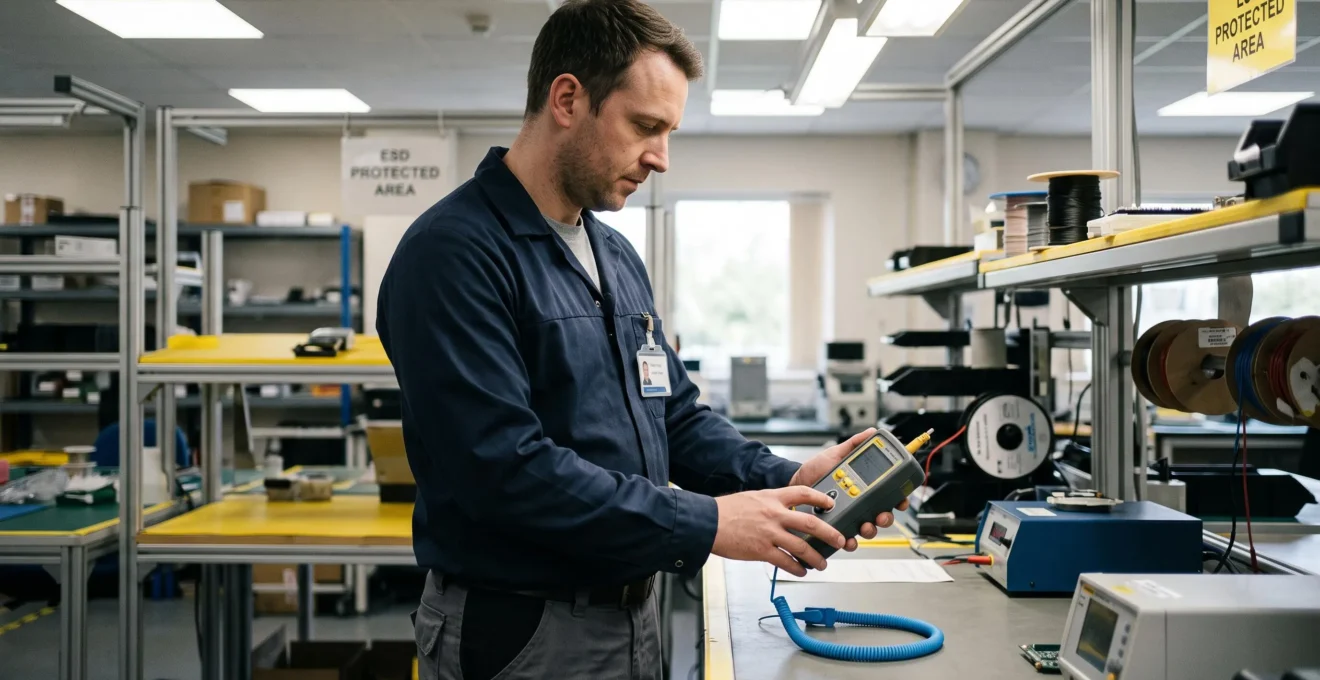
Use a wrist strap tester or suitable resistance meter, comparing results with the acceptance limits set in your ESD control programme plan.
- Review the paperwork
Confirm that test records, training certificates and equipment conformity documentation exist and are up to date.
- Decide item by item
Keep what passes with records to prove it; schedule replacement for what fails; note anything borderline for closer monitoring.
A first-pass check of this kind flags the critical failures quickly. Where the outcome raises doubts — a significant proportion of items failing, or records missing — a fuller assessment of the grounding system, flooring and programme documentation is warranted, drawing on ESD Association guidance or an external specialist if internal competence is limited.
Documentation deserves equal weight to testing. Under HSE guidance, employers must be able to demonstrate that workers received sufficient training on PPE use, and that the equipment has been properly maintained. A simple register — equipment item, test date, result, corrective action, trainer and date for training records — converts compliance from an assertion into evidence.
Common Implementation Mistakes and Building a Sustainable ESD Culture
The most expensive ESD failures rarely stem from never having bought equipment. They stem from buying it once and assuming the job is done. Typical patterns include equipment that is never re-tested after purchase, training delivered once and never refreshed, no defined maintenance ownership, and a paper certification that no longer reflects working reality.
Building something more durable starts with how the equipment is introduced. Resistance to new gear is predictable and manageable when the rationale is communicated honestly and staff have a say in selection — comfort and usability feedback from the people wearing the kit all day is a better predictor of compliance than any catalogue. Recognition of good practice, visible management engagement and refresher sessions tied to real incidents (anonymised where appropriate) all help move ESD from a rule to a habit.
| Criterion | Economy equipment | Premium equipment |
|---|---|---|
| Initial purchase price | Lower | Higher |
| Materials and durability | Generally more wear-prone | Typically longer service life |
| Replacement frequency | Higher | Lower |
| Traceability and conformity documentation | Variable — verify before buying | Generally better established |
| Operator comfort and sustained use | Often the compromise point | Usually a design priority |
The table’s message is not that premium is always right. It is that the comparison must be made across the full life of the equipment, factoring in test pass rates, replacement cycles and training implications — and that the cheaper option is only cheaper if it still protects the product.
Tailored ESD protection: why one size doesn’t fit all : The right answer for an assembly bench is rarely the right answer for an ISO 7 cleanroom or an R&D lab. Suppliers and manufacturers with deep ESD expertise can help match equipment configurations to each environment’s sensitivity, workflow and compliance constraints — a conversation worth having before committing a budget across three very different zones.
Finally, measure the programme. A small set of tracked indicators — proportion of equipment passing periodic tests, completion of scheduled testing, training currency, and any ESD-related incidents or near misses — gives management visibility and gives you the quantitative narrative to justify each budget cycle. It also demonstrates the mindset auditors and customers look for: not “we bought the kit”, but “we know it works because we verify it”.
For teams weighing the wider occupational health dimension of protective equipment decisions, a useful companion read is this definition of occupational health, which situates PPE within the broader framework of protecting and supporting the workforce.
The decision in front of most safety managers is not whether ESD protection is worth funding — the arithmetic of prevention versus failure makes that case itself — but how to direct limited budget where it genuinely reduces risk. Start with the ten-minute health check, document what you find, close the gaps against the compliance baseline, and build the verification and training rhythm that turns equipment into protection. A workforce that is properly equipped, properly trained and periodically verified is the version of “compliant” most likely to hold up in an audit, in front of a customer, or in the ledger.