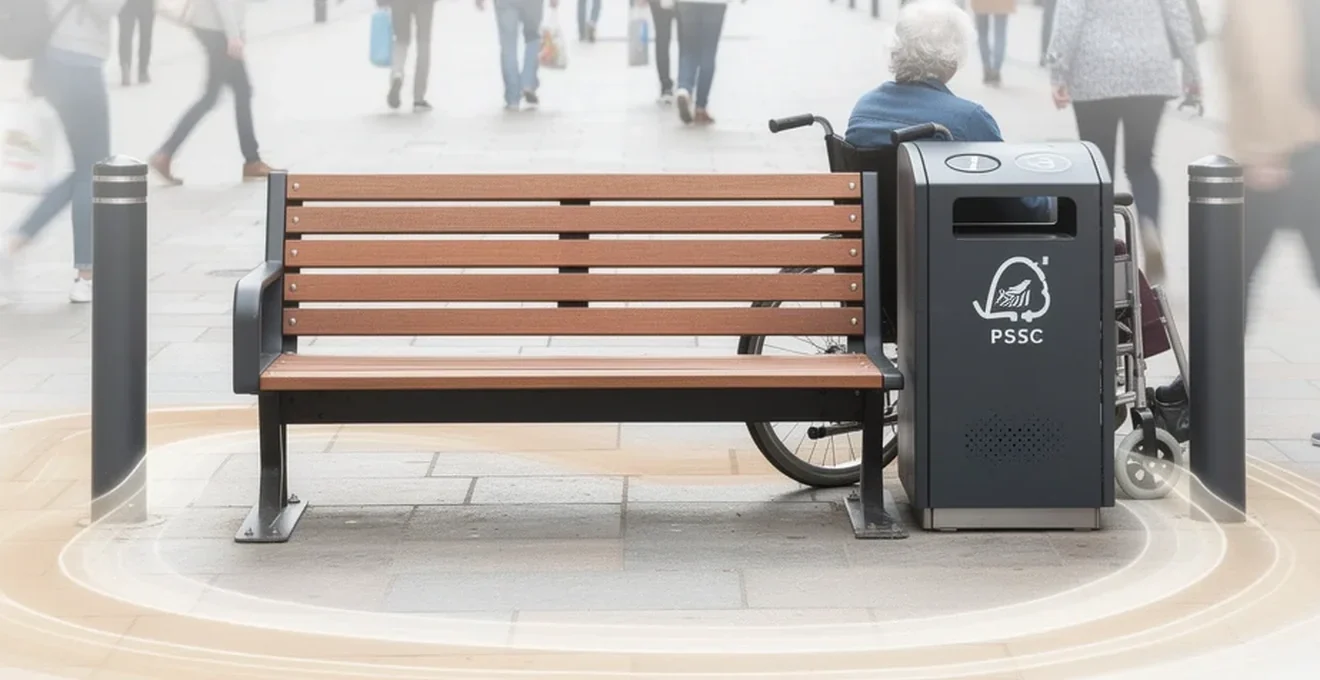
Busy pedestrian areas place unusual demands on street furniture. A bench, bin or bollard that works well on a quiet residential road can quickly become an obstacle, a maintenance headache or a safety risk on a high street handling thousands of footfalls an hour. Choosing the right furniture for these environments means balancing accessibility, durability, safety and aesthetics, while keeping pedestrian flow uninterrupted. This article looks at how footfall data shapes furniture placement, which materials stand up to heavy use and vandalism, how seating and waste management should be designed for mixed-use high streets, and how lighting, signage and cycle infrastructure fit together. It closes with a look at the lifecycle costing and procurement considerations that local authorities and business improvement districts need to weigh up before committing to a streetscape scheme.
Pedestrian flow analysis and footfall data for furniture placement
Before any bench, bin or bollard is specified, planners need to understand how people actually move through a space. Furniture placed without reference to real pedestrian behaviour tends to be either ignored or, worse, becomes a hazard that pedestrians must dodge. Getting this analysis right at the outset avoids costly repositioning later and ensures furniture supports, rather than disrupts, the natural rhythm of a street.
Desire line mapping and pinch point identification
Desire lines are the routes pedestrians naturally take, which don’t always match the paved paths designers intended. Mapping these lines reveals where people cut corners, cluster at crossings, or bottleneck around shopfronts. Pinch points, where the effective width of a walkway narrows because of shop displays, queues or existing furniture, are the areas where new additions are most likely to cause congestion. Furniture should be positioned in relation to the site’s current and desired patterns of use, so it can serve its purpose effectively rather than working against how people already move through the space.
Peak-hour footfall metrics in retail corridors and transit hubs
The intensity of activity in an area should directly inform how much furniture is provided. In high-activity retail corridors, seating should be accessible at least every 60 metres, tightening to every 50 metres where footfall is especially intense. Rest facilities more broadly should appear at intervals of 100 to 200 metres, with the needs of disabled users factored in throughout. Waste receptacles follow a similar logic: on city centre streets, two to four bins per block is generally sufficient, with one placed at each crosswalk end of the block and additional units in the middle where benches or food stalls generate extra litter.
Wheelchair turning circles and DDA-Compliant clearances
Accessible design isn’t an optional add-on; it should be built into every placement decision. Rest areas with benches need at least a metre of adjoining clear space to accommodate wheelchairs, and seating positioned beside a walking path should be set back by 30 to 60 centimetres from the route itself. Table surfaces intended for wheelchair users should sit between 0.75 and 0.90 metres high, with a minimum clearance of 0.6 metres underneath. Waste bin openings should sit no higher than 90 centimetres above ground level to remain usable for wheelchair users. These clearances aren’t arbitrary; they reflect the physical space a wheelchair or walking frame needs to manoeuvre without pedestrians having to divert around furniture that should be helping them, not hindering them.
Sightline preservation around shopfronts and wayfinding signage
Furniture placed near intersections or shopfronts can obstruct the view of drivers and pedestrians alike, particularly if crowds gather around it. This is a genuine safety issue: sightlines to crossings, signage and shop entrances need to remain clear so that pedestrians and any remaining vehicle traffic can anticipate each other’s movements. Where furniture must be positioned near a sightline, keeping its profile low or choosing an open, see-through design (mesh seating rather than solid panels, for example) helps preserve visibility without sacrificing function.
Material selection and durability standards for High-Traffic environments
Material choice determines how well furniture survives constant use, weather exposure and the inevitable attempts at vandalism that heavily trafficked areas attract. The best designs typically use strong, simple shapes and materials suited to their specific context, rather than a one-size-fits-all approach.
Vandal-resistant Powder-Coated steel versus cast iron bollards
Steel is one of the most popular choices for street furniture because of its high strength-to-weight ratio, resistance to corrosion and impact, and low maintenance needs. It’s also fully recyclable and, over its life cycle, relatively cheap compared with alternatives. Steel meshes and bars resist spray paint, burning and slashing far better than softer materials, and their ventilation properties mean they dry quickly after rain. Powder coating adds a further layer of protection and allows bollards to be finished in colours that both suit the streetscape and improve visibility for people with low vision.
Fsc-certified hardwood slats and weathering performance
Wood remains popular for seating because it feels warmer to the touch than metal in cold weather and cooler in hot weather. Its drawbacks are practical rather than aesthetic: it dries more slowly than metal after rain, requires more maintenance, and is comparatively easy to burn, carve or vandalise. Where wood is specified for high-footfall areas, the species and treatment should be chosen with the location and expected frequency of use firmly in mind, since a material that performs well in a quiet park may not hold up on a busy shopping street.
Anti-graffiti coatings and UV-Stabilised polymer composites
Recycled plastic furniture offers a smooth, low-maintenance finish and generally outlasts wood, but it isn’t immune to vandalism; it can still be burned, carved or painted, and standard plastics can degrade under prolonged ultraviolet exposure, which is why UV-stable formulations are worth specifying for anything sited in direct sun for long periods. Any paint or finish applied to street furniture should be non-toxic and non-staining, both for public safety and to simplify cleaning after graffiti or fly-posting.
BS EN 1176 and BS 7818 compliance for public seating
Furniture in outdoor public spaces must be constructed from safe materials and designed to prevent injury, with no sharp edges or exposed fasteners. It should also be fixed appropriately, whether that means anchor bolts into a concrete slab or full embedding in the ground, and the mounting method needs to be decided before manufacture so the furniture is built to suit. Recommended dimensions for benches include a seating height of 42.5cm, a depth of 35–40cm, and a back rest extending 50cm with a 95–100° angle between seat and back rest; seat walls, where used instead of benches, should be 37.5–60cm high (42.5cm is the recommended figure).
Corrosion resistance in coastal towns such as brighton and blackpool
Salt spray, frost and damp sea air accelerate corrosion in exposed metal furniture, making material choice particularly important in coastal locations. Stainless steel’s inherent corrosion resistance makes it a strong candidate for seafront installations, while other metals may need additional protective coatings to achieve a comparable service life. Wherever a location combines heavy footfall with harsh weather exposure, durability testing against local conditions should inform the final material specification rather than relying on generic assumptions.
Bench and seating typologies for Mixed-Use high streets
Seating is one of the most valuable, and most habitually overlooked, categories of street furniture. It supports rest, social interaction and a general sense that a street has been designed with people, not just traffic, in mind. The type of seating chosen should reflect how long people are likely to stay: a shopping street tends to see brief rests, while a park invites people to linger for hours, and that distinction should guide comfort levels and layout.
Backless perch seats for rapid turnover zones
In areas where dwell time is naturally short, such as outside a coffee kiosk or transport interchange, backless perch seating allows quick rests without encouraging prolonged occupation. This keeps turnover high in locations where space is limited and demand for a seat is constant throughout the day.
Modular bench systems around leicester square and covent garden
Modular seating systems can be arranged and reconfigured to suit changing patterns of use, anchoring key spots while adapting to events, markets or seasonal footfall changes. Benches set at right angles to one another encourage conversation between small groups, whereas benches lined up in a row discourage group interaction, better suited to spots with a notable view or heavy passing footfall where people prefer to sit facing outward rather than towards each other. Pairs of benches angled between 90 and 120 degrees strike a balance, allowing both group conversation and solitary sitting without forcing direct eye contact between strangers.
Armrest placement as a deterrent to Anti-Social lying
A centrally placed armrest is a straightforward design measure where discouraging rough sleeping or lying across a bench is a specific concern. Armrests and back supports more broadly assist elderly users getting up and down, and contoured seating with back support is particularly valuable in locations where people are expected to sit for extended periods. The choice of slat size also matters in practice: larger slats are generally less comfortable but may be preferred in areas where people, particularly teenagers, tend to sit on the backrest itself rather than the seat.
Litter, recycling and cigarette bin integration strategies
Waste management infrastructure is easy to overlook until it fails, at which point its absence becomes highly visible. Bins need to be placed where people will actually use them rather than wherever space happens to be free, since pedestrians rarely deviate from their path to find a bin that isn’t conveniently positioned.
Dual-stream recycling units compliant with WRAP guidelines
Clearly labelled, accessible recycling options encourage responsible waste disposal, particularly in areas with heavy footfall from both residents and visitors. Bins should be highly visible and positioned near crossings, takeaway food outlets, bus stops, building entrances and other street furniture such as benches, while remaining set back at least 30cm from walkways and far enough from seating to limit odour and pest issues. Containers with a capacity of 114 to 190 litres are generally sufficient for most public areas, though wheelie bins of 120 or 240 litres may suit locations with particularly high waste volumes, provided collection vehicles can access them easily.
Fire-retardant ashtray bins near licensed premises
Bins sited near bars, restaurants and other licensed premises need to account for cigarette disposal safely, given the fire risk posed by discarded smoking materials mixing with general waste. Dedicated ashtray or cigarette stubber features, built from non-flammable materials, reduce this risk while keeping general litter bins free of smouldering waste.
Solar-compacting bigbelly bins in smart city deployments
In areas of very high footfall, solar-powered compacting bins can hold significantly more waste than standard units before requiring collection, reducing overflow and the associated street mess between emptying rounds. This kind of smart infrastructure fits naturally alongside a broader push towards sustainable street furniture, echoing the wider move towards recycled materials, energy-efficient lighting and other low-impact urban realm solutions.
Lighting, signage and wayfinding furniture coordination
Lighting and wayfinding furniture need to work together, not as isolated installations. Both serve the same underlying goal: helping people feel safe and oriented as they move through a space, whether during the day or after dark.
Bollard-integrated LED lighting for nighttime visibility
Lighting can be delivered through several elements of the streetscape, including bollards, standard street lights and shop windows, and the design should prioritise activity areas and primary walkways after dark. High-pressure sodium lighting, the yellowish-orange type traditionally used in street lights, distorts colour perception and reduces visual clarity, whereas metal halide lighting produces a whiter, more accurate light at lower wattage for the same visibility. Fixed light poles should carry a durable, contrasting marking strip at least 0.3 metres long, positioned at 1.4 to 1.6 metres high, to assist visually impaired pedestrians in locating them.
Legible london wayfinding totem standards
Consistent, recognisable wayfinding is particularly valuable in areas that draw large numbers of first-time visitors and tourists. The Legible London system, identifiable by its black-and-yellow design and detailed local maps, is already familiar across the capital and is designed to help pedestrians move confidently between transport hubs, retail destinations and nearby attractions. Extending established wayfinding networks into newly pedestrianised or redeveloped areas maintains that continuity, reducing confusion and improving both safety and visitor confidence. More generally, signage should favour positive, informative messaging over restrictive “prohibited” language, since giving people confidence to navigate independently improves the overall pedestrian experience. Directional signs should typically be visible from at least 20 metres away, with an effective viewing range of roughly 6 to 47 metres, and lettering should maintain a character width-to-height ratio of between 3:5 and 1:1 for legibility.
Cycle stand placement relative to pedestrian refuge islands
Secure, well-positioned cycle parking keeps bicycles from cluttering pavements and signals that cyclists are a welcome part of the street’s user base. Cycle stands need to be positioned so they don’t compromise pedestrian refuge islands or crossing points, maintaining clear sightlines and unobstructed paths for people crossing on foot. Given the growth in cargo bike and e-bike use in urban areas, reliable parking, whether simple Sheffield stands or more comprehensive travel hubs with repair facilities, plays a meaningful role in encouraging lower-carbon travel choices over private cars or taxis.
Maintenance, lifecycle costing and local authority procurement
The upfront cost of street furniture is only part of the picture. Decisions made at the specification stage have a direct bearing on how much a scheme costs to maintain over years, not just at installation.
Whole-life costing models for street furniture contracts
Quality furniture carries a real cost, which is why it should be reserved for locations where it will genuinely be used and valued. Consistency of manufacturer and furniture type across a site keeps future maintenance and replacement more straightforward and less expensive, since matching parts and finishes remain readily available. Designing furniture with replaceable modular components, rather than fixed, monolithic units, means that damage or wear in one part doesn’t take an entire bench or bin out of service for an extended repair period.
Section 106 funding and business improvement district partnerships
Reinvestment in public realm infrastructure is often tied to wider regeneration efforts, with planning contributions and business improvement district partnerships providing a funding route for higher-specification furniture than routine council budgets might otherwise stretch to. Areas that have seen high-profile retail closures and rising vacancy rates have, in several cases, used exactly this kind of investment in street furniture and public realm improvements as part of a broader turnaround strategy, alongside other regeneration initiatives.
Planned preventative maintenance scheduling for urban realm assets
Vandalism in the form of burning, slashing, carving and spray painting is a realistic and recurring risk for street furniture in busy areas, so maintenance planning needs to account for it from the outset rather than treating it as an unexpected cost. Materials and finishes that resist stickers, graffiti and staining reduce the frequency and cost of repair work. A planned preventative maintenance schedule, built around routine inspection rather than waiting for visible damage to accumulate, keeps furniture functional and visually consistent, which matters as much for public perception of an area as for the practical performance of the furniture itself.